
Part 1: Implementing a nature-positive finance initiative on deforestation-free supply chains
|
Graphical Abstract: Implementing a nature-positive finance initiative on deforestation-free supply chains |
1. Executive summary
The global economy remains deeply dependent on commodities linked to deforestation and ecosystem degradation. Agricultural commodities such as soy, palm oil, beef, cocoa, coffee, rubber, timber, and pulp and paper products continue to drive forest loss across tropical and subtropical regions. Financial institutions, corporations, investors, and consumers often remain indirectly connected to deforestation through complex global supply chains, including embodied deforestation embedded within imported commodities and manufactured products.
At the same time, emerging regulatory frameworks, investor expectations, and international biodiversity commitments are reshaping market incentives. Governments, financial institutions, and corporations are increasingly expected to identify, assess, disclose, and mitigate nature-related risks and impacts. Nature-positive finance has emerged as a critical approach for redirecting capital flows away from activities that contribute to ecosystem degradation and toward activities that protect, restore, and sustainably manage natural capital.
This initiative seeks to establish a comprehensive research, policy, and assessment platform focused on deforestation-related risks within global supply chains. It will generate evidence, develop policy recommendations, publish opinion and thought-leadership pieces, and assess the role of financial institutions, corporations, and academic actors associated with commodities linked to deforestation. Particular attention will be paid to imported commodities and products containing embodied deforestation.
The initiative aims to strengthen accountability, improve transparency, support sustainable finance practices, and contribute to national and international efforts to halt and reverse deforestation.
2. Background and Rationale
## 2.1 Deforestation as a Financial and Economic Risk
Deforestation contributes significantly to biodiversity loss, greenhouse gas emissions, water stress, soil degradation, and disruption of ecosystem services. It creates material risks for:
* Financial institutions through credit, investment, underwriting, and reputational exposure;
* Corporations through supply-chain disruptions and regulatory liabilities;
* Governments through climate and biodiversity commitments;
* Investors through stranded assets and transition risks;
* Consumers through reduced sustainability and product traceability.
Deforestation-related risks are increasingly recognized as systemic financial risks. Nature loss can affect economic productivity, commodity markets, and long-term investment performance.
## 2.2 Embodied Deforestation and International Trade
Many countries are net importers of commodities associated with forest loss. Deforestation impacts may occur abroad while consumption occurs domestically. This phenomenon—often referred to as embodied or imported deforestation—creates challenges for policymakers and market actors seeking to reduce environmental footprints.
Examples include:
* Soy used in animal feed;
* Palm oil used in food and consumer products;
* Cocoa and coffee imports;
* Leather and beef products;
* Timber, pulp, and paper products;
* Rubber and biofuel feedstocks.
Now, understanding these embedded impacts is essential for effective nature-positive finance strategies.
## 2.3 Growing Regulatory and Market Drivers
Several developments are increasing demand for deforestation-related due diligence:
* Nature-related financial disclosure frameworks;
* Sustainable finance taxonomies;
* Supply-chain due diligence regulations;
* Biodiversity commitments under international agreements;
* Net-zero and nature-positive corporate commitments;
* Responsible investment standards and stewardship expectations.
These developments create opportunities for evidence-based policy interventions and independent assessments.
# 3. Vision
To promote financial systems and supply chains that are aligned with nature-positive outcomes by reducing deforestation-related risks, improving transparency, and supporting responsible investment and trade practices.
# 4. Mission
To generate robust evidence, policy recommendations, and accountability mechanisms that help financial institutions, corporations, governments, and academic stakeholders identify and address deforestation embedded within commodity supply chains.
# 5. Strategic Objectives
The initiative will pursue five interconnected objectives:
### Objective 1: Conduct High-Quality Research
Develop rigorous research on:
* Deforestation-linked commodities;
* Trade flows and embodied deforestation;
* Financial sector exposure;
* Nature-related financial risks;
* Supply-chain traceability;
* Biodiversity and climate implications;
* Emerging regulations and market responses.
### Objective 2: Produce Policy Briefs and Recommendations
Generate actionable policy outputs addressing:
* Sustainable finance regulations;
* Deforestation-free procurement policies;
* Trade and customs measures;
* Disclosure requirements;
* Financial sector due diligence;
* Biodiversity finance frameworks.
Table 1 Potential global policy interventions to disrupt financial pathways driving deforestation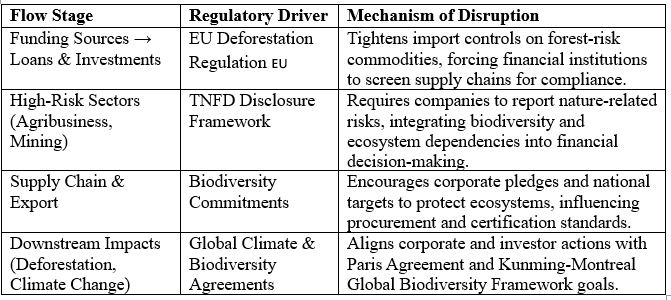
### Objective 3: Publish opinion pieces and thought leadership
Develop accessible publications that:
* Raise awareness among policymakers and investors;
* Highlight emerging risks and opportunities;
* Translate technical findings into public discourse;
* Influence market practices and regulatory debates.
Fig. 1 River‑flow diagram with regulatory overlays added shows where global policy interventions can disrupt the financial pathways driving deforestation.
### Objective 4: Assess financial institutions and corporations
Evaluate how institutions manage deforestation-related risks through:
* Lending policies;
* Investment portfolios;
* ESG frameworks;
* Supply-chain commitments;
* Disclosure practices;
* Engagement and stewardship activities.
### Objective 5: Map Academic and Knowledge Ecosystems
Assess academic institutions and researchers engaged in:
* Commodity trade research;
* Supply-chain sustainability;
* Biodiversity economics;
* Nature finance;
* Environmental governance.
The objective is to identify knowledge gaps, collaboration opportunities, and research priorities.
# 6. Scope of Assessment
## 6.1 Commodity Coverage
Priority commodities include:
* Palm oil
* Soy
* Beef and leather
* Cocoa
* Coffee
* Rubber
* Timber
* Pulp and paper
* Biofuel feedstocks
* Maize and animal feed commodities
Additional commodities may be included based on country-specific relevance.
Table 2 Measurable policy‑impact with quantitative indicators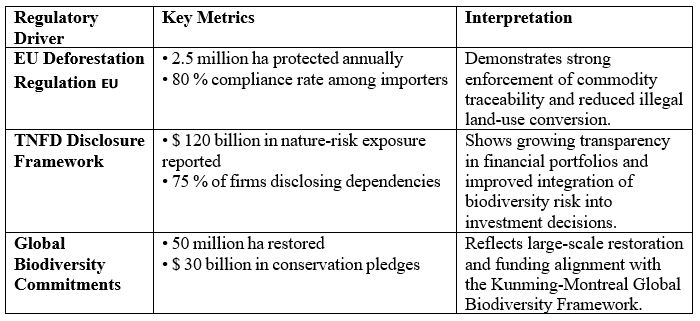
## 6.2 Financial Sector Coverage
Assessment will include:
* Commercial banks
* Development finance institutions
* Export credit agencies
* Institutional investors
* Asset managers
* Pension funds
* Insurance companies
## 6.3 Corporate Coverage
Assessment will focus on:
* Commodity traders
* Importers
* Manufacturers
* Retailers
* Consumer goods companies
* Food and beverage companies
Fig. 2 Measurable policy‑impact map involving regulatory drivers with quantitative indicators
## 6.4 Academic and Research Institutions
Assessment areas include:
* Research outputs;
* Funding sources;
* Policy engagement;
* Methodological innovation;
* Contribution to public debate.
# 7. Research Framework
The initiative will adopt a multi-dimensional framework based on:
### A. Exposure
What commodities are linked to deforestation risk?
### B. Dependency
How dependent are institutions on forest-risk commodities?
### C. Impact
What environmental impacts are associated with activities and investments?
### D. Governance
How are risks identified, managed, and disclosed?
### E. Transition Readiness
How prepared are organizations for emerging regulatory and market expectations?
## 8. Methodology
#Quantitative Analysis
* Trade-flow analysis;
* Input-output modelling;
* Supply-chain mapping;
* Financial exposure assessment;
* Portfolio screening;
* Commodity risk modelling.
#Qualitative Analysis
* Policy reviews;
* Corporate disclosure analysis;
* Stakeholder interviews;
* Expert consultations;
* Case studies.
# Benchmarking
Development of scorecards assessing:
* Policy commitments;
* Implementation mechanisms;
* Transparency;
* Monitoring systems;
* Traceability;
* Performance outcomes.
##9. Key Outputs
# Research Reports
* Commodity-specific studies;
* Financial exposure assessments;
* Country-level analyses;
* Sectoral reports.
#Policy Briefs
Short evidence-based recommendations targeted at:
* Governments;
* Regulators;
* Financial institutions;
* Industry associations.
##Opinion and Commentary Articles
#Regular publications on:
* Emerging regulations;
* Market trends;
* Nature-positive finance developments;
* Investor expectations.
## Deforestation Finance Scorecard
#A recurring benchmark evaluating:
* Financial institutions;
* Corporations;
* Supply-chain actors.
#Academic Landscape Reports
Mapping key researchers, institutions, and research gaps.
10. Partnerships
Potential partners include:
* Financial regulators;
* Central banks;
* Development organizations;
* Universities;
* Think tanks;
* Investor networks;
* Commodity certification initiatives;
* Civil society organizations.
11. Expected Outcomes
Short-Term (1–2 Years)
* Improved awareness of imported deforestation risks;
* Enhanced policy dialogue;
* New datasets and evidence generation;
* Increased stakeholder engagement.
Medium-Term (3–5 Years)
* Better disclosure and transparency practices;
* Strengthened due diligence systems;
* Greater integration of nature-related risks in finance;
* Improved supply-chain accountability.
Long-Term (5+ Years)
* Reduced financing of deforestation-linked activities;
* Increased investment in sustainable land-use systems;
* Greater alignment of trade and finance with biodiversity goals;
* Contribution to nature-positive economic transformation.
12. Monitoring and Evaluation Indicators
Key indicators may include:
* Number of research publications produced;
* Number of policy briefs issued;
* Media and policy citations;
* Financial institutions assessed;
* Corporations benchmarked;
* Academic institutions mapped;
* Stakeholder engagements conducted;
* Policy reforms influenced;
* Improvements in disclosure and due diligence practices.
13. Conclusion
Addressing deforestation requires moving beyond conservation-focused approaches and engaging directly with financial systems, commodity markets, and global trade networks. By combining rigorous research, policy engagement, public thought leadership, and institutional assessments, this initiative seeks to advance a nature-positive finance agenda that addresses both direct and embodied deforestation risks. The initiative will provide evidence, accountability tools, and practical recommendations to support the transition toward deforestation-free supply chains and more sustainable financial flows.
For a funding proposal or institutional strategy document, this base paper can be expanded further with: (i) a detailed theory of change, (ii) a results framework and logframe, (iii) a financial institution assessment methodology aligned with the Taskforce on Nature-related Financial Disclosures framework, and (iv) a dedicated section on trade-linked deforestation relevant to major importing economies such as India, the European Union, the United Kingdom, and United States.
14. References
Dasgupta, P. (2021). The economics of biodiversity: The Dasgupta review. HM Treasury.
European Commission. (2023). Regulation (EU) 2023/1115 on the making available on the Union market and the export from the Union of certain commodities and products associated with deforestation and forest degradation (EUDR). Official Journal of the European Union.
Food and Agriculture Organization. (2022). The state of the world’s forests 2022: Forest pathways for green recovery and building inclusive, resilient and sustainable economies. FAO.
Forest Trends. (2023). Finance and deforestation: Tracking financial institution exposure to forest-risk commodities. Forest Trends.
Global Canopy. (2023). Forest 500 annual assessment report 2023. Global Canopy.
Global Canopy. (2023). The little book of investing in nature. Global Canopy.
Intergovernmental Science-Policy Platform on Biodiversity and Ecosystem Services. (2019). Global assessment report on biodiversity and ecosystem services. IPBES Secretariat.
International Institute for Sustainable Development. (2021). Nature-positive economy: A pathway to sustainable development. IISD.
Organisation for Economic Co-operation and Development. (2023). OECD business and finance outlook 2023: Financing the transition to a sustainable future. OECD Publishing.
Pendrill, F., Persson, U. M., Godar, J., Kastner, T., Moran, D., Schmidt, S., & Wood, R. (2019). Agricultural and forestry trade drives large share of tropical deforestation emissions. Global Environmental Change, 56, 1–10. https://doi.org/10.1016/j.gloenvcha.2019.03.002
Persson, U. M., Henders, S., & Kastner, T. (2014). Trading forests: Quantifying the contribution of global commodity markets to emissions from tropical deforestation. Environmental Research Letters, 9(11), 114007. https://doi.org/10.1088/1748-9326/9/11/114007
Principles for Responsible Investment. (2022). Managing deforestation and forest-risk commodities: A guide for investors. PRI.
Science Based Targets Network. (2023). Science-based targets for nature: Initial guidance for business. Science Based Targets Network.
Taskforce on Nature-related Financial Disclosures. (2023). Recommendations of the Taskforce on Nature-related Financial Disclosures. TNFD.
United Nations Environment Programme. (2021). State of finance for nature 2021: Tripling investments in nature-based solutions by 2030. UNEP.
United Nations Environment Programme Finance Initiative. (2023). Nature target setting framework for banks. UNEP FI.
United Nations Environment Programme Finance Initiative & Global Canopy. (2024). Beyond deforestation: Financial sector approaches to managing nature-related risks. UNEP FI.
United Nations Framework Convention on Climate Change. (2022). Sharm el-Sheikh implementation plan. UNFCCC.
World Bank. (2023). Nature-related financial risks: A framework for policy makers and financial supervisors. World Bank.
World Economic Forum. (2020). The future of nature and business. World Economic Forum.
World Resources Institute. (2023). The state of forest governance and commodity-driven deforestation. WRI.
WWF. (2022). Deforestation fronts: Drivers and responses in a changing global economy. WWF International.
Zhunusova, E., Senf, C., Baumann, M., et al. (2022). Mapping and understanding deforestation risk in global commodity supply chains. Nature Sustainability, 5(6), 489–497. https://doi.org/10.1038/s41893-022-00879-8
Additional specialised references for the assessment methodology section
Taskforce on Nature-related Financial Disclosures. (2023). Guidance on the identification and assessment of nature-related issues: The LEAP approach. TNFD. https://tnfd.global/publication/additional-guidance-on-assessment-of-nature-related-issues-the-leap-approach/
TNFD – Taskforce on Nature-related Financial Disclosures
Global Canopy. (2023). Forest 500: 2023 assessment methodology [PDF]. Forest 500. https://forest500.org/reports/
Global Canopy. (2025). Forest 500: 2025 assessment methodology [PDF]. Forest 500. https://forest500.org/wp-content/uploads/2026/04/2025-Forest-500-Methodology.pdf
CDP. (2025). CDP full corporate scoring methodology 2025: Forests. CDP. https://assets.ctfassets.net/v7uy4j80khf8/tx9Ydi2dYFSdAzZXJqbQZ/47034be6390c37bb789933327544239f/CDP_Full_Corporate_Scoring_Methodology_2025_-_Forests.pdf
Accountability Framework Initiative. (2020). Operational guidance: Achieving commitments through collaboration. Accountability Framework Initiative. https://accountability-framework.org/the-accountability-framework/operational-guidance/
Accountability Framework Initiative. (2025). Operational guidance: Commitments and progress pathways. Accountability Framework Initiative. https://accountability-framework.org/the-accountability-framework/operational-guidance/
Accountability Framework Initiative. (2025). Accountability Framework: Core Principles, Operational Guidance, and definitions [ZIP file]. Accountability Framework Initiative. https://accountability-framework.org/the-accountability-framework/download-the-full-framework/
Science Based Targets Network. (2024). Guidance on science-based targets for nature. Science Based Targets Network.
https://sciencebasedtargetsnetwork.org/how-%20it-works/the-first-science-based-targets-for-nature/
Science Based Targets Network & Textile Exchange. (2025). Guidance on science-based targets for nature: For the fashion, apparel, and textile industry (Version 1.0). https://textileexchange.org/app/uploads/2025/02/Guidance-on-Science-Based-Targets-for-Nature.pdf
United Nations Environment Programme Finance Initiative. (2023). Nature-based risk assessment: Integrating project-related finance and managing nature-related risks. United Nations Environment Programme. https://www.unepfi.org/publications/nature-based-risk-assessment-integrating-project-related-finance/
World Benchmarking Alliance. (n.d.). Nature Benchmark methodology. World Benchmarking Alliance. https://www.worldbenchmarkingalliance.org/benchmark/nature-benchmark